Tuesday, April 27, 2021

Birds of the Miracle Tree

The miracle tree is one of the many names the Maringa tree (Moringa oleifera) is called.  The health benefits of this fast-growing, drought-resistant tree are well documented, boasting many important vitamins and minerals that are good for the body.  Though native to the Indian subcontinent it is quickly finding its place here on the island and it seems like the birds are enjoying it too.  My parents has a plant on their property and my mother told me that she is seeing more hummingbirds visiting the tree, since the heavy ashfall that occurred as a result of the eruption of the La Soufrière volcano on the neighboring island of St. Vincent. 

Green-throated Caribs were the most numerous bird species I saw
I was doing some work there over the weekend and took my camera along. The tree was flowering and was alive with activity.  Birds and insects were busy going from flower to flower taking their sweet nectar but also taking pollen with them to other flowers for pollination, there was an increase in activity for sure. 
Antillean Crested Hummingbird
From my previous visits I knew the smaller of the two hummingbirds we have on the island, the  Antillean-crested Hummingbird (Orthorhyncus cristatus), was the most numerous species i saw at the tree, but they were now being outnumbered by the larger  Green-throated Carib (Eulampis holosericeus).
 A Bananaquit taking a drink from on of the Maringa tree flowers
Another nectivorous bird species also present was the Bananaquit (Coereba flaveola). These flowers were just the right size for their sharp decurved beck because we all know what happens to flowers that are too large for that bill to reach the nector - the Bananaquit uses its beak to pierce the base of the flower.  In most cases it may not harm the plant, but does not assist in the pollination process as no pollen is transferred from the flower to the bird's bill hence no pollination. 

Barbados Bullfinch
Two non-nectar feeding birds that visited the tree were Barbados Bullfinch (Loxigilla barbadensis) and Eurasian Collared-Dove (Streptopelia decaocto)The Bullfinch no doubt fed on the small insects that were attracted to the flowers but why was the dove there?  It was eating the complete flower of the tree.  I am simply amazed at how adaptive to various environments these birds are, no wonder there are spreading across the Americas at such an alarming rate.
Carpenter Bee
The visitor to the Maringa tree that deserved an honorable mention has wings and flies but is not a bird.  It is the Carpenter Bee (Xylocopa violacea?). unlike the hummers who made a fuss, fighting and all, these bees played their roll, feeding and pollinating, slow and could even say methodically, without any fuss. 
Without fuss and unassuming is how this fast-growing, drought-resistant, miracle tree that is the Maringa tree (Moringa oleifera) presents itself, but I am observing that it is not just a miracle tree for us humans, but also the birds, bees, and other animals. 

Stay safe

Saturday, April 24, 2021

Over 100 Turnstones at Inch Marlow

Ruddy Turnstone beautifully adorned in breeding plumage 

I made a midday stop yesterday (April 23rd) at Inch Marlow Beach, Christ Church to see what birds were there.  

Looking South toward the Inch Marlow's peninsula
The beach and the sea were bursting with Sargassum Seaweed, the golden color of the fresh seaweed dominated the sea and shoreline, while the older one was further back on the beach.  The tide and the winds were high, causing angry waves to throw a tantrum as there lash against the unyielding rocky shores of the peninsula, but effortlessly reshaping the sandy shores at Long Beach to the north. 

Ruddy Turnstones at various stages of molting

A few species of shorebirds were on the rocky shore. They were a Least Sandpiper (Calidris minutilla), Semipalmated Plovers (Charadrius semipalmatus)(4), Sanderlings (Calidris alba) (5), but the bird that dominated was the Ruddy Turnstones (Arenaria interpres) (111) at various stages of molting to breeding plumage.

Sanderlings and Ruddy Turnstones
The birds appeared to be mostly at rest, punctuated periodically by self-grooming and the preening of feathers.  Ruddy Turnstones are one of the most colorful shorebirds when in breeding plumage and we are having a front-row seat of this transformation.  Disappointedly there are some of the few birds we get to witness make this full yearly change, as many of them, like the Sanderlings (Calidris alba), will begin the process here, but will migrate before the process is complete.  I am hoping to document as many species as possible, especially shorebirds, as their change to breeding plumage.   

Until the next post stay safe. 


Tuesday, April 13, 2021

April Images: First Half Of the Month

I had a slow photographic and birding start to the month of April, but I am happy to still be able to share a few images with you.   As we approach the end of the month I will be searching for birds migrating north to their breeding grounds, but for now please enjoy this mixture of some of our locally nesting birds, starting with portraits of two iconic local species -    

Grey Kingbird
Carib Grackle


Juvenile Common Gallinule in the canal at Graeme Hall Swamp


Juvenile Common Gallinule again

A Cattle Egret with dirty plumage from the ash fall from the La Soufriere volcano in the neighboring island of St. Vincent 


Snowy Egret at Chancery Lane 


The tinny Black-faced Grassquit

Adult Black-crowned Nightheron

oops! not a local breeder but a migrating visitor,
 Short-billed Dowitcher


Tuesday, March 16, 2021

Birding after the Pause – week 2

In the second week since returning to work after the Pause, I got out to a few of the birding locations I missed during the first week.  I was concentrating more on photography, and becoming more familiar with the Canon 7D MKII which led to a few impromptu photoshoots when finding willing feathered models, common or rare, local or migrant, it mattered not.  This drive gave me a fair week of birding and photography, in which I tallied 43 species and captured many gigabytes of RAW images. The major stops I made were at Oistins Fishing Complex, Redland, North Point, and Woodbourne Shorebird Refuge (WSR) but also got images from across the island at common "none-birding" locations.

On the afternoon of Monday 8th, I stopped at The Oistins Fishing Complex, Christ Church, which is on the South Coast, to look for seabirds.  A few Laughing Gulls (Leucophaeus atricilla) and Royal Terns (Thalasseus maximus) were perched on one of the piers.  The Royals were at the far end of the pier, too far for the Canon EF-s  55-250mm. The Laughers, on the other hand, were much closer so I focused on the one closest to me.  It was an adult in breeding plumage, showing its black head with a pronounced eye-ring.

Laughing Gull


A beautiful Spotted Sandpiper (Actitis macularius) also in breeding plumage drew my attention away from the gulls and I was able to capture a few images before it disappeared behind a bolder.

Spotted Sandpiper in breeding plumage

The next time out birding was on Wednesday afternoon (March 10th), but this time at the opposite end of the island,  North Point, St. Lucy. The wet area there has long dried up as we are now in the dry season but a few birds, both native and migratory,  can normally be found along the tundra-like flats to the south of the wetland area.  I saw 5 species of shorebirds, as I hiked along the rocky terrain.(Black-bellied Plover (Pluvialis squatarola), Semipalmated Plover (Charadrius semipalmatus)Sanderling (Calidris alba)Least Sandpiper (Calidris minutilla) and Semipalmated Sandpiper (Calidris pusilla)).

Least Sandpiper
Black-bellied Plover


Three Black-bellied Plovers at North Point
The next day I made a short stop at one of the irrigation ponds at Redland to check out an interesting-looking domestic duck that was hanging around with Muscovy Ducks (Cairina moschata)It was a beautiful duck, probably Mallard (Anas platyrhynchos) mixed.  Four Blue-winged Teals (Spatula discors), two males in breeding plumage, and two females were also on the pond along with a few shorebirds. 

domestics Muscovy Duck
and other hybrid 


Solitary Sandpiper 
                                                                                                                                                                                                                                                                                               

Male and Female Blue-winged Teals

For the second week straight, Friday afternoon found me at the WSR.  The light was not as good as it was last week but I still got a few images.      

A remnant of the 100 Teals @ WSR, notice the Green-winged Teal leading the flight 

Solitary Sandpiper 

comparison between Lesser (front) and Greater (rear) Yellowlegs 

I had no plans for birding on the weekends because some of the COVID restrictions were still emplace, but on Saturday 13th, I took my son to an appointment and while waiting for him I did a bit of drive by birding and photography in the area.   Some of the highlight sightings and images included three Golden Warblers (Setophaga petechia) foraging among a grove of mature Acacia trees, and an Osprey (Pandion haliaetus).

Yellow (Golden) Warbler can always be found in or around
Acacia trees 
 

Zenaida Dove (Zenaida aurita)


Osprey 


Sunday, March 7, 2021

After the Pause

The first week back to work after the “pause” was surprisingly busy.  It was good to be out of the house after weeks of confinement but I was a little nervous, even a little afraid because of the pervasiveness of COVID in society.  The routine of mask and face shield has become the norm for me, and disposable gloves are added to the mix depending on where I am going. It was refreshing being outdoors, seeing the different birds as I moved around the island. After work, on most of the days, I visited a few of the birding hotspots, utilizing that activity for exercise as afforded by the government's COVID-19 protocols.  During that week I tallied 32 bird species from 8 checklists, also adding 2 yearbirds namely Caribbean Martin (Progne dominicensis), which I saw in Bridgetown and Laughing Gulls (Leucophaeus atricilla) at Pile Bay.  You can see the full list of the birds I saw below.

I continue to be impressed with the Canon 7D Mark II, even as it is paired with the underwhelming (because of reach) Canon EF-s  55-250mm f/4 – 5.6 IS II, which effectively becomes 89.1 - 405mm (x1.62 crop sensor of the Canon 7D II).  Here are a few highlight images for that week. All images were lightly edited using Adobe Lightroom CS2.

On March 1st I had my best look at a Merlin (Falco columbarius) for the year. It was going after Eurasian Collared-Doves (Streptopelia decaocto) for dinner, and while the shots I got were not ones I would normally highlight, I love this one that shows the beautiful barring pattern in this raptor's tail. 

© Julian Moore  - birdingbarbados@gmail.com
Merlin showing its tail feathers  (1/4000 @ f8 ISO 1000 – 250mm)

On the 3rd, my after work exercising took me to Chancery Lane Swamp, Christ Church. While there, I tried to photograph an American Coot (Fulica Americana) with her chicks.  This was not an easy task as both mum and chicks played peek-a-boo with me, using the mangroves for cover.  While I easily got images of both of them alone, the image below was the only opportunity I had of them together.

© Julian Moore  - birdingbarbados@gmail.com
Adult (1/1000 @ F/8 ISO 640 250mm)
 
© Julian Moore  - birdingbarbados@gmail.com
Juvenile  (1/1000 @ F/8 ISO 640 250mm)


© Julian Moore  - birdingbarbados@gmail.com
Mother & Chick ((1/1250 @ F/8 ISO 640 250mm)

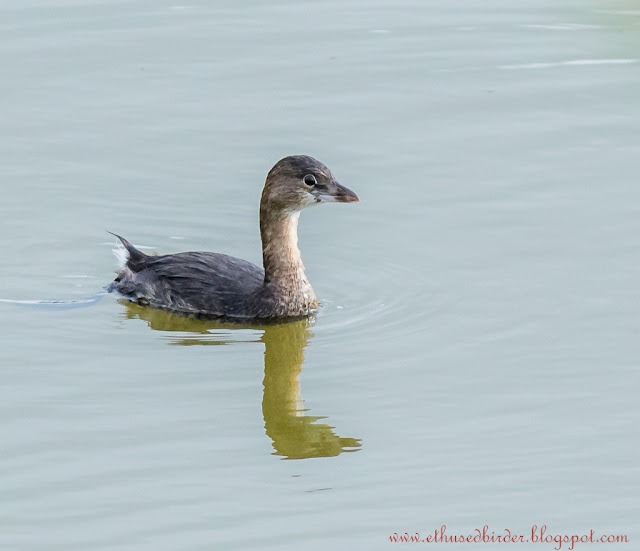
The following day, the 4th, I ended work in the north so I visited the irrigation ponds at Bawdens, St. Andrew, and had a short photo session with a pair of Pied-billed Grebes (Podilymbus podiceps).  

© Julian Moore  - birdingbarbados@gmail.com
Pied  (1/1600 @ F/5.6 ISO 640 250mm)

© Julian Moore  - birdingbarbados@gmail.com
The Pair (1/1250 @ F/8) ISO 640 250mm)

My last stop for the week was at the Woodbourne Shorebird Refuge (WSR) on Friday, March 5th.  The water in most of the ponds was evaporating making foraging by wading birds much easier.  This triggered a small feeding frenzy among various species of waterbirds.  In one pond I counted 7 species of heron/egrets tallying 22 birds, 6 species of shorebirds, and in another, 68 Blue-winged Teals (Spatula discors), only a fraction of the 111 seen just a few days before. My most exciting capture, though, was that of a Sora (Porzana Carolina). This was the best look I’ve had of this shy bird for the year.  I would’ve love to get even lower but two things prevented that: first, I would have to take my camera close to the water in the pond, too close for my comfort.  Even though it is weather-sealed I am not ready for that adventure as yet with this babe. Secondly,   I am always skeptical of lying, sitting, walking in the grass, fields, or even the paved road in the parish of St. Philip.  It is notorious for its forty legs, its big, long, ugly stinging CENTIPEDES and I don’t mess around with those things.  Here are a few of the images from WSR.


© Julian Moore  - birdingbarbados@gmail.com
Sora (1/1000 @ F/8) ISO 1000 250mm)


© Julian Moore  - birdingbarbados@gmail.com
Greater & Lesser Yellowlegs
(1/3200 @ F/8) ISO 1000 250mm)


© Julian Moore  - birdingbarbados@gmail.com
Lesser in flight (1/2500 @ F/8) ISO 1000 250mm)


© Julian Moore  - birdingbarbados@gmail.com
Little Egret in flight (1/5000 @ F/8) ISO 1000 250mm)

These are the birds I saw during the first week of March

  1.  Black-bellied Whistling-Duck - Dendrocygna autumnalis
  2. Blue-winged Teal - Spatula discors
  3. Green-winged Teal - Anas crecca
  4. Pied-billed Grebe - Podilymbus podiceps
  5. Scaly-naped Pigeon - Patagioenas squamosa
  6. Eurasian Collared-Dove - Streptopelia decaocto
  7. Common Ground Dove - Columbina passerina
  8. Sora - Porzana carolina
  9. Common Gallinule - Gallinula galeata
  10. American Coot - Fulica americana
  11. Least Sandpiper - Calidris minutilla
  12. Wilson's Snipe - Gallinago delicata
  13. Spotted Sandpiper - Actitis macularius
  14. Solitary Sandpiper - Tringa solitaria
  15. Greater Yellowlegs - Tringa melanoleuca
  16. Lesser Yellowlegs - Tringa flavipes
  17. Laughing Gull - Leucophaeus atricilla
  18. Royal Tern - Thalasseus maximus
  19. Red-billed Tropicbird - Phaethon aethereus
  20. Brown Booby - Sula leucogaster
  21. Great Egret - Ardea alba
  22. Little Egret - Egretta garzetta
  23. Snowy Egret - Egretta thula
  24. Little Blue Heron - Egretta caerulea
  25. Cattle Egret - Bubulcus ibis
  26. Green Heron - Butorides virescens
  27. Merlin - Falco columbarius
  28. Gray Kingbird - Tyrannus dominicensis
  29. Caribbean Martin - Progne dominicensis
  30. Carib Grackle - Quiscalus lugubris
  31. Grassland Yellow-Finch - Sicalis luteola
  32. Bananaquit - Coereba flaveola  


Thursday, February 18, 2021

Great Backyard Bird Count 2021

Carib Grackle
This was the first  Great Backyard Bird Count (GBBC) that I spent solely counting in my backyard.  Normally for this four-day international event,  which ran this year from February 12-15th, I would have visited a few local birding locations and would have ended the event with 35+ species recorded.  This was not possible this year because the island is on “pause” because of the second wave of the COVID virus.  The GBBC is an event that engages birders from across the world, of all ages, in counting birds to create a real-time snapshot of bird populations worldwide.  Participants are not tied to their backyards but can submit a checklist from any location.

A female Shiny Cowbird
I did my count on the morning of February 13th. A Carib Grackle (Quiscalus lugubris) and a Bananaquit(Coereba flaveola) are both in the process of constructing a nest in the Bajan (Barbados) Cherry Tree (Malpighia emarginata) just outside my bedroom window, and I realized that it attracted a lot of other species.  Where ever Carib Grackles are nesting you will find Shiny Cowbirds (Molothrus bonariensis)  and four of them came to the tree.  Cowbirds are brood parasites, in that they lay their eggs in another bird's nest, relying on them to raise their young.  Carib Grackles are the main host for this behavior.  I was soon joined by a pair of Yellow Warblers (Golden) (Setophaga petechial) and three noisy Caribbean Elaenia (Elaenia martinica) on my back fence.
Eurasian Collared-Dove
All in all, I saw only a few common birds, like Eurasian Collared-Doves (Streptopelia decaocto), Cattle Egrets (Bubulcus ibis) and Gray Kingbirds (Tyrannus dominicensis), and I tallied 13 species in 30 minutes. See the full list below

  1. Scaly-naped Pigeon (Patagioenas squamosa)
  2. Eurasian Collared-Dove (Streptopelia decaocto)
  3. Zenaida Dove (Zenaida aurita)
  4. Cattle Egret (Bubulcus ibis)
  5. Rose-ringed Parakeet (Psittacula krameri)
  6. Caribbean Elaenia (Elaenia martinica)
  7. Gray Kingbird (Tyrannus dominicensis)
  8. Shiny Cowbird (Molothrus bonariensis)
  9. Carib Grackle (Quiscalus lugubris)
  10. Yellow Warbler (Golden) (Setophaga petechia)
  11. Bananaquit (Coereba flaveola)
  12. Barbados Bullfinch (Loxigilla barbadensis)
  13. Black-faced Grassquit (Melanospiza bicolor)

Saturday, February 6, 2021

Highlights and Images from January

As I said in a previous post, my birding will be very low key this year, but when you look at my activity for January you may feel I was joking.   The fact is I  tallied 68 species in 21 outings during the month, an all-time high for me.  This came about because I was involved in a region-wide conservation program directed by Birds Caribbean called the Caribbean Waterbird Census or CWC, which got me out during the month.  It also afforded me the time to get more familiar with my new camera, the Canon 7D MK II.  Even with the sub-par Canon EF-S 55-250mm IS II lens that I paired it with I was very surprised by this beast.  I am still figuring out some of the bells and whistles (man this thing has lots of them) but I am happy with the results.  For February, the island will be on lockdown, at least for the first half of the month but my goal would be to photograph the birds around my curtilage. (One of my new COVID words).

I wish you all a great and productive month of February. Remember to follow the protocols and stay say.  I hope you enjoy the images below from the month of January.

Semipalmated Plover
(Charadrius semipalmatus)


Least Tern (Sternula antillarum)

Sanderling (Calidris alba)


Sanderling (Calidris alba)

Green Heron (Butorides virescens)


Cliff Swallow
(Petrochelidon pyrrhonota
)


Cliff Swallow 
(Petrochelidon pyrrhonota
)

Lesser Scaups (Aythya affinis)


American Coot (Fulica americana)